Cakewalk
Come hungry.

EVERY RED-HOT SUMMER, IN A TOWN CALLED WAR, there was a cakewalk. Grand, brilliant, and ravenous, the perfect marriage between the overabundant splendor of nature and the insatiable greed of man. Packed on the small, winding roads that curled into the West Virginia mountainsides, wagons of wealthy coal families trudged in for this celebratory retreat, desperate to escape the more uptight and regal atmosphere provided by their elite planting rivals in the coastal states. War was landlocked, rugged, shining in the coal dust, emerald trees poking into the blinding sun, simmering with music and moonshine and smoked jerky and yearly gossip.
The town itself, also called Miner’s City, was a working-class town. Aside from the Cakewalk, which was reserved for only the most powerful businessmen, War hosted rollicking parties and games to get peoples’ minds off working in the mines. These weren’t the New England balls and swanky tea lunches for frill-collared dignitaries and their dogs; it was, for lack of a better term, a rager. Blue-collar barbeque. Leave your formalities in the dirt. While the rest of the community rejoiced in the structured summer activities, the richer folks—by invitation—would slip away for the one-night endeavor of the Cakewalk. Once you were invited to the Cakewalk, you were sworn to secrecy on the details, which changed year to year. But the rules remained the same:
Be courteous
Dress your Sunday best
Prepare to spend top dollar
Come hungry
As much mystery there was surrounding the events of the Cakewalk, citizens far and wide knew of its mythical fame. There was a certain level of prestige associated with the invitation, so those on the list quickly banded together upon arriving at War, happy to meet their fellow panjandrums. The days leading up to this particular Cakewalk were feverish indeed, on the twentieth anniversary of West Virginia’s statehood, limber pale bodies reddened by heat and beer, chanting songs and playing darts over the creek.
Another community in War was also preparing for the Cakewalk. If you stayed still enough to watch what you thought were trees, you’d notice their brown skin in the dogwood, watching. They were the ever-silent hosts, ageless guardians, unknown to any patron who was not native to War. Even after emancipation, they had stayed, continuing their honored tradition on the grounds their masters had once owned. As more white people swarmed the town, the hosts would open their tradition to the visitors—with a few modifications. A game. Perhaps even a sport, in that all definitions of the word could fittingly describe the Cakewalk: exertive, satirical entertainment. And so began the most well-known secret in West Virginia; that the Cakewalk was something like a revenge pageant, and maybe it didn’t feel so good to win.
Be courteous.
The annual prey received the address on the first night. By Sunday, they were ready: powdered and pressed and arrogant as hell.
As the couples and bachelors descended into a secret place in the woods, they found each other, the other distinguished guests, and exchanged pleasantries.
Not that this matters anymore, but there were quite a few heavy hitters on the list: Archibald Westley (as bigoted as it sounds), one of the premier slavers of St. Lucia until it was outlawed; Emmy Fontaine, daughter of a cotton empire and learned equestrian; Jacob Brown, a handsome and wealthy Southern trader; William Dougherty, renowned English scholar and anthropologist; and Peter Preston Kraw, the newest, and yet somehow oldest, name in coal.
All were rich beyond belief, with no plans of coming down. And with all of the similarities these people had with one another, there was absolutely no kinship. No camaraderie. Their smiles were white with surrender and their eyes were sharp as knives. But rules were rules, and number one was to be courteous. Everyone attended the Cakewalk to take part in the spectacle, the decadence. Petty rivalries and disputes were to be put aside for as long as the event lasted. War had to be at peace.
Dress your Sunday best.
Chartreuse and olive-green, deep wine coats and jewel-toned summer gowns, the prey looked like a basket of ripe fruit as they entered the forest. It wasn’t as hot anymore as the sun retreated and the longer layers provided some relief from nosy mosquitos.
Popular to the Gilded Age style, the wives resembled down-turned buttercups, plumes of silk and lace unraveling from their bustles. The lace, as if by magic, never seemed to catch on the twigs and rocks while they walked.
Alongside them, their husbands looked like lampposts in tall narrow hats, tight-fitting suits, and shoes that shone as bright as the moon. They made sure to hold tight to their purses and the wives clutched their paper fans. Despite being in the middle of the verdant wilderness, the Cakewalk was about keeping up appearances. There was a constant need to prove oneself. Dress for attention, for status, for God. It was all the same here.
Prepare to spend top dollar.
Amongst the prey, bets would be made. After all, the Cakewalk was a competition, and the top prize was always an unthinkable surprise. This year, Emmy Fontaine and Jacob Brown paired together: if Jacob ensured her a skilled, healthy housekeeper (no older than thirty) from the region, she’d allow his company to be the primary trader of her father’s cotton empire. Jacob had priority as a man to bid on the property of his choice, but they were already engaging in a torrid affair unbeknownst to his wife, so he owed Emmy something.
Archibald Westley already had more enslaved beings than he needed, some still locked in various estates or loaned out to friends and politicians. But he made a deal with the anthropologist, William Dougherty, who would use his winnings to conduct invasive research in the name of Western science. And Peter Preston Kraw was looking to buy the whole damn charade: the hosts, the Cakewalk, the town of War, the surrounding mountain region that bled black with coal. He could own it all without a fight but he wanted the fanfare, so the Cakewalk would be the perfect party to ring in his aspirations.
Bet on your dancer or wait on the auction. If you weren’t sure what to spend your money on yet, the abundant feast and a strong drink would sway your mind. The prey were giddy with excitement, their senses heightened by the final rule:
Come hungry.
What does that mean?
Come hungry.
For what, exactly?
Come hungry.
Why?
Come hungry.
The hosts did not cook. There was no feast. In fact, the only thing to eat had taken them an entire year to prepare.
Can you guess what that is?
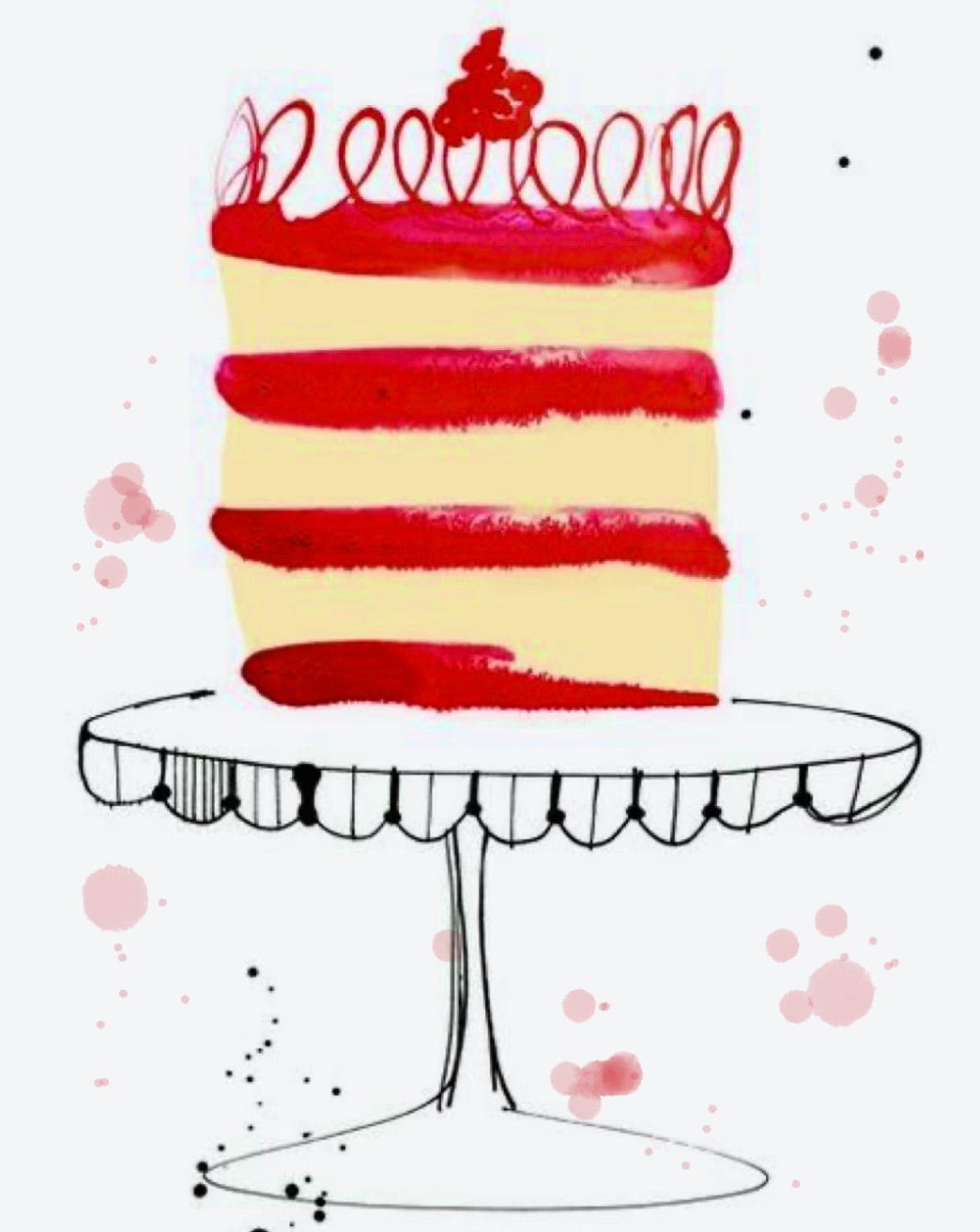
The cake was magnificent: four tiers high, with lily-white vanilla buttercream and beet-colored icing swirling around each layer. If you were to cut it open, you’d be welcomed by rich red velvet and a thick chocolate scent that felt like the earth herself. Every year, the cake was the prize, although the guests—the prey—they didn’t know that. The “cakewalk” name seemed to always fly over their heads.
The hosts elected a Baker every year to lead the construction of the cake. It was a great honor among the Black community of War to be named the Cakewalk’s Baker. In 1886, they chose a fourteen-year-old girl named Nel. Nel was tenacious with a tall and boyish frame, wide eyes, and dark coils spun into assorted knots on her head. She wasn’t a conversationalist or a warrior, but she held the weight of the world in her gaze and the strength of fifty men behind a tightly closed mouth. Nel was the only child who had witnessed a cakewalk and the youngest to demonstrate her desire to take part. But what was even more exciting—curious and chilling, all the same—was that the Baker kicked off the event. And no one was prepared to see a slim, fourteen-year-old Black girl standing on the center pic-a-nic table in the woods, flanked by her fellow hosts, stone-faced, as she muttered the order:
“Dance.”
The prey all looked at each other, some stifling uncomfortable chuckles and amused inquiries. The white elite had made themselves comfortable in the pic-a-nic arrangement, the trees around them decorated with lights and colorful streamers. They regarded the Black gathering a few yards away, eyeing them tastefully or not at all. Emmy pointed out her choice to Jacob. William inspected the men particularly. Peter Preston Kraw barely took notice; he was just ready for the monkeys to jump. Archibald was extremely peckish at this hour and demanded to know where the feast was, to no avail. The hosts simply watched them. You’d think they’d know English by now, Archibald said into his beard. The awkward silence between the two groups stretched on in the warm dusk until Nel made her way through the hosts and climbed atop a pic-a-nic table.
“Dance,” she said.
Yes, dance! Emmy’s tone was as high as helium, the way you would speak to a dog. We’re here for the dance!
Nel raised an eyebrow. “Then dance.”
You’re mistaken, girl, laughed Archibald. That’s what you’re here for.
“Indeed.” Nel clucked her tongue. Two men carried out the spectacular cake, placing it beside her on another wooden table blanketed in yellow cloth. “This is the Cakewalk. All of you will dance. You will dance for the prize. You will eat when you win.”
What?
This is ludicrous!
That bitch must be dumb!
Nel clucked her tongue again and another mass of Black hosts emerged from the bushes behind the prey, eyes steely, whips in hand. The prey all began to squirm, cursing and spitting, disgusted and bewildered by what was transpiring before them. This is not the Cakewalk?! What is this? Where did all these niggas come from? Jacob whirled around to face Nel again, a swoop of brown hair falling over his sweaty forehead. Do you know who you’re threatening? Do you know who you’re messing with?
“No,” replied Nel. A smirk tugged at the corner of her wide lips. “Do you know where you are?”
None of them knew. They had all followed the invitations to the serene woodland miles from War, in whatever direction the creek followed. No one could answer. “Well then, that is settled. It’s time to start. I’m sure you would all like to eat, so our event is simple. Dance.”
Or what? You’ll starve us?
“See for yourself.” Nel waved her hand and suddenly, a piano chord jangled in the summer air. Everyone flinched, turning to see an older Black man sitting at a beautiful wooden piano, carved straight out of the trunk of a tree. It looked like something out of a storybook; the man’s back curved forward, fingers rippling across the keys in a ragtime song, foot tapping in the grass. The piano was a little out of tune but still full, sounding centuries old. The hosts behind the prey harshly nudged them up, cracking their whips in warning. The rest of the hosts sat down at the other pic-a-nic tables, watching expectantly. Nel took a deep breath, inhaling the music, and stepped down into the tall thickets of bluestem. Another musician accompanied the pianist on drums and another on banjo. Soon, a full band had formed from the hosts, flashing gummy smiles and exchanging quips. The West Virginia forest became lively with music, reverberating in the soil between Nel’s toes, and thumping to the heartbeat of Mother Nature. The prey, dressed in their finest linens and jewels, awkwardly swayed their bodies to the beat, looking at each other with puzzlement.
Then, a burly host cracked his whip against the side of a tree. “You call that dancin’?”
Archibald spat at him. Mind your mouth, boy!
This host, however, was far from a boy. With terrifying strength, he yanked Archibald down to the ground by his frilled collar. The older white man tumbled, nose first in the dirt, barely able to catch his bearings before the host kicked his face in. All it took was one kick. The bone cracked and bent inward into Archibald’s brain, like a smashed watermelon. Emmy screamed. Nel did not react.
“I thought y’all liked competition!” called another host, a curvaceous woman with a cloud of hair. “We’re not gonna say it again. You dance, you eat. You don’t, we will.”
Nel nodded. “Assume waltz positions!”
The prey, horrified, scrambled into pairs within the clearing. Waltz music started playing—but it was fast, like really fast. The prey fought to keep up, hard at first, with adrenaline that only came from blind fear. The ladies’ bustles bounced and the men’s hats wobbled, every step and spin and dip adding to the syrupy weight of the air. If any of them slowed or stopped for breath, a host would crack their whip, and that energy would find its way back. The waltz got faster still, transitioning to a polka. The hosts took in the spectacle with glee, clapping along.
Knee up, kick right and down.
Knee up, kick left and down.
Knee up, kick right and down.
Knee up, kick left and do-si-do.
Knee up—
Perspiration pooled in the undersides of Emmy’s bosom. Jacob’s hair was a mop. William, used to being relegated to a desk, was not faring well either, breath haggard. Peter Preston Kraw was more hungry than he was tired and kept dancing. The magic three a.m. hallucinations were beginning to kick in. One by one, the white guests began to fall. Some protested this contest and were swiftly taken care of by the hosts. Some were too exhausted to continue and dry-heaved on empty stomachs. The older elites and some women, in all their heavy garments, simply fell faint. Gaudily decorated bodies littered the forest clearing, surrounded by otherwise jovial music and entertained Black folk. Nel had not sat down once during the cakewalk, calmly surveying the remaining participants. She could tell by their labored winds and faltered steps who would most likely be the final candidate; who would fight and who would flee. The stragglers would be caught easily before reaching the creek, a place that had become a graveyard over the years. The hosts never used guns, as the sound would alert War to the true nature of the Cakewalk, so whips were used to ensnare and punish. Never to death. The prey deserved longer, lonelier deaths; hidden away into erasure just like the millions of African souls buried in the dirt or in the oceans.
Knee up, kick right and down.
Knee up, kick left and fown.
Kne up, king right nd downa
Kmee up kick let and do-si-ood
Knee doen, no up
Up and down. Hungry. Up up up up up.
Peter Preston Kraw had chewed off the flesh around his nails to keep from going crazy. By dawn, he was one of three left forced to stare at the rising orange blaze, tangoing barefoot on quarry rocks and smoldering lumps of coal. By noon, after parading in circles up and down the steep mountainside, crowing like a chicken, newly charred feet descending from pain to numbness, he had won the Cakewalk.
It wasn’t a joyous win. Peter was so consumed by hunger that he leaped at the cake when it was presented to him in silence, not sparing anyone whatever was left of his concentration.
Nel was disappointed in this year’s winner. She’d have to let him go. He had too big of a reputation for the hosts to wrap things up as usual. But the rest of them were not so easily defeated.
“We can make sure he doesn’t talk.”
“How?” Nel couldn’t stop watching the grotesque old man stuff his face with red velvet cake.
One of the hosts grimaced before gesturing at their own mouth.
“Really?” Nel raised her eyebrows. “Is everyone in agreement?”
The hosts nodded.
“May I do the honors?”
“Of course.”
Nel nodded and emerged from the group. She retrieved the knife used to cut the cake and approached Peter Preston Kraw. Peter looked up with dizzy self-righteousness. This is the sick game y’all do every year? He nearly choked on a bite. Very clever, but you’re not proving what you think.
“And what’s that?” Nel asked.
You’re only showing your true selves, Peter said. We knew that all along. Savages, the lot of you. What has this done but prove us right?
Nel’s grip on the knife tightened. “Prove to who?”
Peter stopped chewing.
Nel was a young woman, but faster than she looked. It did not take long to force the man’s mouth open with a ferocity that made his jaw snap. The knife’s blade felt cold under his tongue, where the sensitive, warm veins still pulsed. Nel jacked her elbow up violently, digging, scooping. The hosts stood in a circle, again, watching. Peter’s gurgled screams were trapped in the branches of arrowwood, no louder than the afternoon birds or clanging of the nearby mines. The tongueless man would not return to War until much later that day, but by then, all of the wealthy visitors would have left for home, and the Cakewalk was just another summer myth. War did not have a very good memory.
Nel allowed another individual to take the Baker’s responsibilities the following year. She had satisfied her youthful rage, but it would come back. She did not yet know a grown, womanly rage—the fury embodied by her sisters and foremothers, the ones who had lived through the emancipation and had only known twenty years of freedom. Nel realized, as she grew older and the Cakewalks continued, that this was only a small retribution for her community. There were others like it, hidden in free Black settlements, secretly nestled next to white towns—like eyelashes, not there until you thought about them.
Maybe the cycle would grow tired, but Nel never allowed herself, or the Blacks of War, to become bitter. Murder did not have to be resentful. Revenge did not have to be coldhearted. In fact, it could be a romp; a caricature of justice. It could be sweet and full-bodied, crafted by brown hands and devoured by greedy pink mouths, and both the hosts and prey would laugh as it went down, red icing staining their perfect, stolen teeth like blood.