Monstera
a short story

“THE EARTH SWALLOWED THEM WHOLE,” began my great-grandmother softly, her grayed eyes set like stone on the horizon of our endless country lawn. Her hands, brown skin pulled tight around the knuckles and rough with love, rhythmically drummed against the ends of her wicker chair. “Swallowed them as if the wilderness itself was insatiable and impatient to grow. The lake went back but the vines danced. No one heard them scream.”
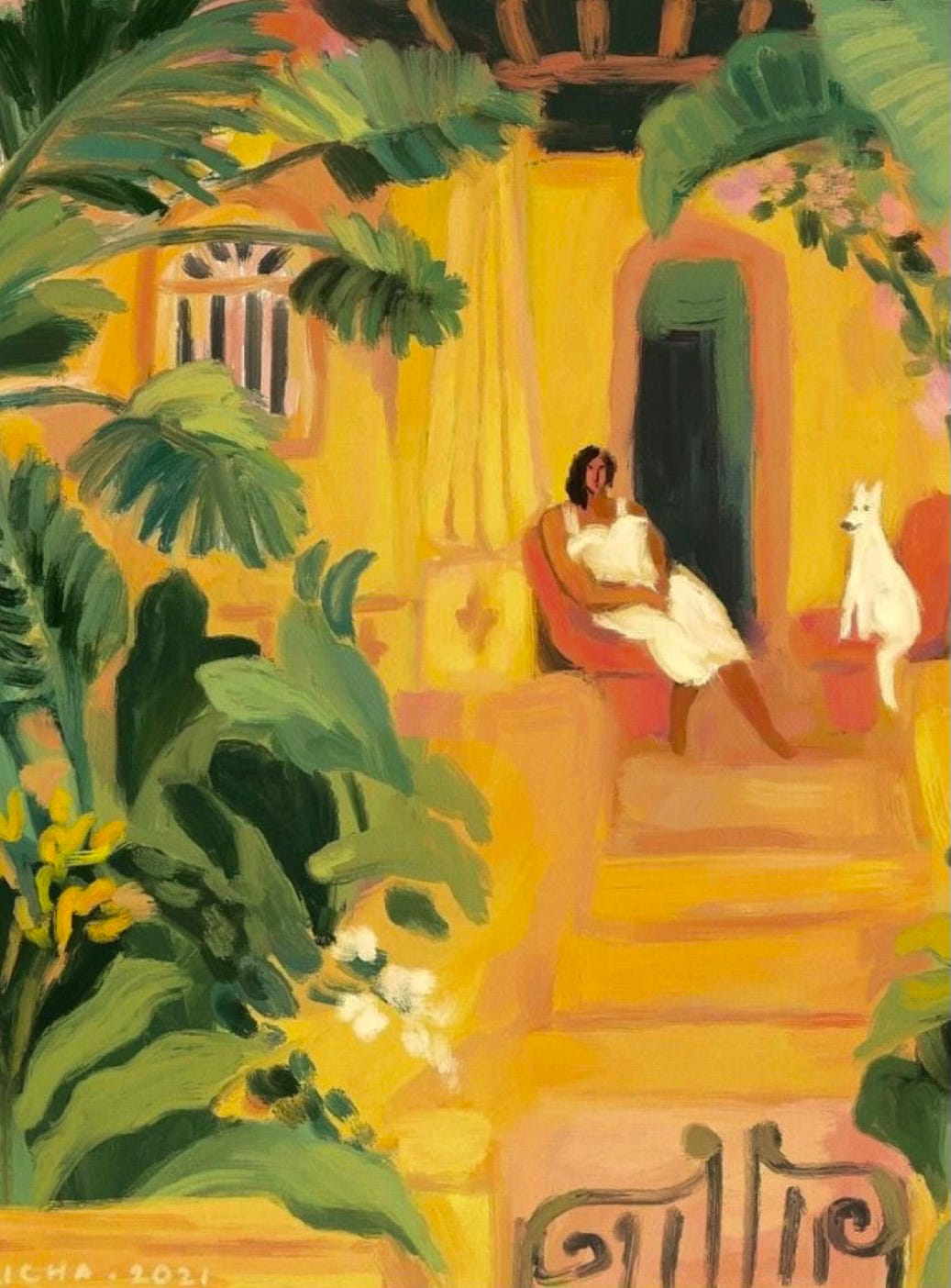
I peered up at my Nana Rose from below on the porch staircase, gripping a watered-down ice tea between my knees. The June humidity was an unwelcome companion, sticking my thighs down like flypaper and forcing my hair to curl where it met my forehead. Maybe it was that companion that compelled Nana to speak, whereas we had spent most of the day in silence, like usual, when I returned from summer classes at the college downtown. She liked to keep her afternoon routines ever since her third husband died: buttered toast, iced tea, four wedges of an orange. On the harder days, I held the oranges to her mouth and Nana would eat from my hand, gaze lost in the kudzu or the sky. On the better days, the food would be gone before I even arrived. However now, I wasn’t quite sure what kind of day it was or would be. Nana watched the dusk as if it was talking back to her. I chose to be its voice: “The earth swallowed who, Nana?”
“Groundskeeper,” she said immediately, “old groundskeeper. A baby, barely awake. The house’s first son.”
“Is this something you read today, Nana?” I asked, leaning back on my elbows. I had told Maurice to stop leaving the fucking newspapers around the house. They confused her. “It probably didn’t happen here. You don’t have to worry about it.”
“I saw it.”
“Yes.” I learned better than to argue. “But I am saying you don’t have to worry about it.”
“Groundskeeper kept the land in order. When he was taken, the Missus noticed.”
Missus was a forbidden word in Nana’s stately Southern ranch—unless, of course, it was accompanied by a formal address: “Mrs. Finnel from the bank,” or “Mrs. Wilson the fifth-grade teacher,” or “Mrs. So-And-So who is all up in my business.” But the one and only Missus was a dark cloud on a clear day. You could see the past wash over Nana like an unholy sea, agony and contempt so vivid that it painted the walls. Mom would occasionally fill in the gaps about Missus, probably to save Nana the turmoil in her older years, probably to stop me from asking. I didn’t need to know much when our family name held the answer, being bestowed by the Missus herself one-hundred-and-fifty years ago.
I took a deep breath, choosing my words carefully. “Let’s not talk about her, Nana. You don’t like her.”
A wry smile tugged at Nana’s lips and she bent over her chair like a great oak tree, the floorboards creaking beneath her. “No. Neither did the earth.”
“Right.”
“Rozi.”
“Yes, Nana?”
“I saw it.”
“Yes. I believe you. You’ve seen a lot of things. That’s why I like sitting with you.”
“Your mother didn’t believe me.” Nana took a bite of her toast, and her words flitted into the wind as if they were never meant to reach me. I stared at her, growing curious. “And bless her, she thought I was talkin’ crazy because my daughter prolly said I talked crazy. But I know what I saw. The earth’s jaws were made of mud and vine, it coiled around your ankles after hours in the field. I was familiar, so I knew it’d never get me. The earth understood my pain because I had buried it. I buried my friends, my family. The earth knew every soul on the plantation. It took years for me to speak its language and avoid its wrath.”
I was quiet, meek, like I was five again. “What kind of wrath?”
“Nature, Rozi,” replied Nana with a satisfied nod, “nature’s wrath. Its promise to take back its home, right human wrongdoings. Nature took back the groundskeeper first. He was a foul man with a cruel mouth. I remember the uneven poke of his yellow teeth. He watched us work in every minute of the sun’s light. He held a, wus-it-called? A riding crop, he held a riding crop.” She flinched. “Mm-mm. Terrible man. And the earth knew his soul, just like everyone’s. The earth sat under him in anguish.”
“How did you know it was in anguish?” I asked.
“Pay attention, I said I spoke its language,” she snapped.
I made sure she didn’t see me smile. “Of course, sorry.”
Nana chuckled, tapping her foot against my outstretched forearm. She motioned to stand and I mounted the porch to help. On her feet, she was a few inches shorter than I, silver curls pressed flat at the back of her head from the chair. Nana squeezed me—thank you—and we slowly walked down to the lawn, where the meadow flourished in the orange light. Nana liked to say that it was “thoughtfully overgrown,” which it was. Somehow the weeds were not ugly or invasive here, sometimes erupting in gorgeous blossoms and clusters of color. Bees and butterflies and birds dipped in and out of the high grasses, an endless bounty of life.
Nana brought me to the edge of the yard, where a tall and thick forest surrounded the house. She bent down to a kneeling position in front of me and placed her hands in the dirt. “Now listen, Rozi.” She patted the ground. “This earth has more eyes than men. It has been here since time began and will be here far longer than any of us. It knows good and evil. So it’s not crazy to say that the earth under the plantation was haunted. Seething with disturbed soil. And one day…” Nana cupped her shaking hands into the ground, gathering up the dirt, and smoothed it over my bare feet. She did this a couple of times, until my feet were fully submerged, until I became a human tree. “The dirt moved like this over the groundskeeper’s feet. It was fast. It caught him in his stride, like a pothole, and tightened. He fell forward into the field. I remember freezing, not knowing what to do.”
I was transfixed by her storytelling. “Did he call for help?”
Nana looked up at me and lifted a single finger. “Once.”
“Then what?”
Still kneeling, she reached for some vines of ivy at the base of the forest. Delicately, she began to wrap the vines around my ankles. Her eyes were full of childlike wonder, maybe a touch of horror. “The ivy seized him. Legs first, then arms, then mouth. He couldn’t yell no more when the ivy got to his mouth. And finally, it went quiet.” Nana stood up and turned away from me, looking across the lawn. “I went to see but the earth already took him. There was a hole in the field. Maybe to hell. Then it closed like it was never there.”
I wiggled my toes beneath the soil, but I was stuck there. Planted. “Nana, can you teach me its language?”
She didn’t turn back around. “You already know.”
Suddenly, there was a sharp tug at my heels and my stomach dropped like I was being sucked underground. However, it felt more spiritual. I couldn’t quite describe it. My body remained in the same physical space in the forest, but my consciousness was being dragged down into the roots of the trees below and around me, spreading out as far as the evening light could reach. I wanted to yell or something, alarmed by the abrupt trance, my soul floating and sinking and traveling to another plane of reality entirely. After a moment, I looked up towards the direction of the house, but it was no longer there. In fact…the world around us seemed to be moving in reverse. Days scrolled by, then months and years: the light dusting of snow, fallen leaves reattaching themselves and uncurling into flushes of green. The forest grew and waned over and over, every burst of new flora feeling almost orgasmic, and the dying plants felt like needlepoints of pain. I was both a part of the earth and witnessing it—of dust, we were born and to dust, we will return. Nana turned back to look at me, now unrecognizable: skin supple and smooth, youthful eyes, and curly hair dark as night.
When I spoke, I couldn’t hear myself: “What is this? What’s happening?”
“You’re Rooting,” Nana said in a voice decades younger. “Daughters of our family have always been able to tap into this gift. The men cannot bear the weight.”
“Rooting…” I repeated, in shock. I was floating but bound, and instead of air in my lungs, it was time.
Nana was patient. “It is as real as you and me. It would be naïve to conclude that Earth exists separate from humanity, from life itself. Earth gives birth, she feels pain, she witnesses and retaliates. In the deepest, most secluded places of the world, she is just as alive as we are.”
Whispers and ghosts of thoughts trailed through my veins: a child’s laughter, a mother’s cry, a brother’s warning. Memories and dreams filled the spaces between roots—and I felt it all, as overwhelming as it was. “Are we the only ones?”
“Most indigenous peoples have some form of this communication. That way they can connect with their ancestors and loved ones.” Nana swept her skirts up to kneel on her bare knees, placing both of her palms flat in the grass. “Your cousins are attuned to water, but I don’t dare to follow those spirits.”
“Why?”
“There are some depths you cannot travel back from.” She slammed the grass and a resounding rumble made my heart skip a beat. “There is a pain that no person should ever know. Our ancestors refused to carry it on land, so they buried it in the ocean. I consider it mercy.” The plants around us began to shake and grow, fat sprouts of monstera leaves covered my vision, Spanish moss dragging at my arms, the sickly sweet scent of magnolias beckoning me into their slumber. I saw—in my mind, rather, not with my eyes—the wretched groundskeeper, thrown back up from the ivy. I saw the snow-white baby, unearthed and returned to a picnic blanket. I saw the rigid stature and severe frown of the Missus, surveying the property. She purposely avoided our direction and I felt the rageful blood rushing through Nana. Time surged forward again, the people gone, voices collecting in my head as more souls cycled through to the present. The prayers of escaping bondage, a secret love affair, a wounded soldier whispering his goodbyes. Inexplicable tears came to my eyes. Black people have gone through so much. In heartbreak and desecration and injustice, we had still prevailed. And the earth was the only true recordkeeper.
I was dizzy when the ivy let go of me, falling forward into the grass. Nana, with her familiar wrinkles, gently touched my cheek.
I leaned into her hand. “How do you control it?”
“It can’t be controlled,” she replied, “only accessed.”
“Why are you showing me this now?”
Nana smiled, and the answer was clear. “My Rozi, one day our afternoon visits will look very different. They can live forever, but only if you study the Root. When we don’t share our stories, entire histories are lost to time. But the memory here?” She plucked my chin. “And here?” She lifted her wide eyes to the forest. “It is eternal.”
Filled with emotion, I wrapped my arms around her legs. “I believe you.”
She huffed, spunk snapping back into her small figure. “Help me back on this porch.”
We mounted the steps, sitting through the sunset in sparse conversation. My skin still felt alive with the lingering energy of the woods, the immense burden and freedom of being linked to generations before me, the acute awareness of realities I had lived and not lived. It terrified me and thrilled me and yet, I felt comforted. As long as I honed this power, I would never be alone.
Mom came home late from her shift, and by that time, I had already left dinner in the fridge and put Nana to bed. I was finishing up some homework in the blue-lit living room when Mom stopped in front of me: “How’d it go?” I didn’t know how to answer. She laughed. “You’ll get used to it.”
“When did you learn?” I leaned forward.
“I was younger. Grade school, maybe.” Mom sighed. “The real trick is learning to stop. Some memories are too heavy. You have to protect your own heart to keep from being consumed.”
I practiced Rooting every evening after Nana went to bed. It took a few tries to get the positioning right, a more secluded spot in the woods to let me focus, to clear my mind of any thoughts. Some days, I came home frustrated from school or a disagreement and decided not to practice. My life already had its own weight, and on those days, I did not want anymore. But as my powers grew, as the seasons changed and the world swelled around me with new life, I could hear the voices even when I wasn’t trying. I could feel an avalanche as it reclaimed the land, rivers and lakes claiming evil souls, dark forests hiding a fringe of humanity that bordered on feral. All secrets now. And I held the key.
When the earth took back Nana’s body, some three summers later, a garden flourished around her gravestone, watered by my tears. Her voice remained the loudest whenever I traveled through Alabama, asking for more orange slices or why the President hadn’t found his way to the ivy yet. Some judgments are beyond my doing, I reassured her. But he’d find his time. We all would.
And maybe that was the consolation that came with these cultural, omnipresent gifts: this world was the same world our parents’ belonged to, their parents and on and on. Despite the good we do, perhaps some evil, the achievements and struggles and small moments—they lived on in a deathless cycle, living and learning and resting in the very same clay that forged civilization and carved life into the stars.